 The Congo Institute
The Congo Institute, also known as the African Training Institute, was established in 1890 at Myrtle Villa, Nant y Glyn Road, Colwyn Bay by a returned missionary and pastor in the town, Reverend William Hughes.
Reverend Hughes, who was a friend of Sir Henry M Stanley whom he had met while a missionary in the Congo, returned to Wales in 1885 with two Congolese students and settled at Colwyn Bay, living on charity and money collected at lectures. He believed the African students should be given a Christian education and trained in a craft apprenticeship, such as carpentry, printing, tailoring, blacksmithing etc.

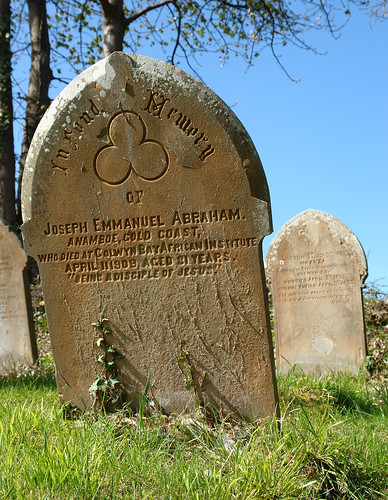
The intention was that they would then return to Africa and act as missionaries in their own country. Students attended Tabernacle Welsh Baptist Chapel, Colwyn Bay and Calfaria Welsh Baptist Chapel, Old Colwyn. In the Old Colwyn cemetery there are gravestones of Congolese students who died in the area. Although well-supported locally, the Institute was not without its troubles and Hughes' ideas were unpalatable to the Baptist Church Missionary Society.
He was financially naïve, and in 1911 faced national scandal at the hands of John Bull magazine - akin to today's tabloids - which suggested the Africans were 'walking in the woods with local ladies' of an evening. In a story which appeared in the magazine, Hughes was also alleged to have fathered an illegitimate child by a Congolese woman. Hughes decided to sue the editor, Horatio Bottomley, but lost his case at Ruthin Assizes. Subscriptions to the Institute dried up immediately, the remaining students were sent home to Africa and, the following year, Hughes was declared bankrupt. He died at Conwy Workhouse on 28 January 1924.
At its peak the institute trained around 60 students. King Leopold II of Belgium was its patron. North Wales explorer, H M Stanley also gave lectures in support of the institute.
The Congo Institute building (Myrtle Villa) survives on Nant Y Glyn Road to this day (albeit greatly altered) as the NHS Clinic at 19 Nant Y Glyn Road - the map below shows the location of the Institute:
Reverend Hughes, who was a friend of Sir Henry M Stanley whom he had met while a missionary in the Congo, returned to Wales in 1885 with two Congolese students and settled at Colwyn Bay, living on charity and money collected at lectures. He believed the African students should be given a Christian education and trained in a craft apprenticeship, such as carpentry, printing, tailoring, blacksmithing etc.
The intention was that they would then return to Africa and act as missionaries in their own country. Students attended Tabernacle Welsh Baptist Chapel, Colwyn Bay and Calfaria Welsh Baptist Chapel, Old Colwyn. In the Old Colwyn cemetery there are gravestones of Congolese students who died in the area. Although well-supported locally, the Institute was not without its troubles and Hughes' ideas were unpalatable to the Baptist Church Missionary Society.
He was financially naïve, and in 1911 faced national scandal at the hands of John Bull magazine - akin to today's tabloids - which suggested the Africans were 'walking in the woods with local ladies' of an evening. In a story which appeared in the magazine, Hughes was also alleged to have fathered an illegitimate child by a Congolese woman. Hughes decided to sue the editor, Horatio Bottomley, but lost his case at Ruthin Assizes. Subscriptions to the Institute dried up immediately, the remaining students were sent home to Africa and, the following year, Hughes was declared bankrupt. He died at Conwy Workhouse on 28 January 1924.
At its peak the institute trained around 60 students. King Leopold II of Belgium was its patron. North Wales explorer, H M Stanley also gave lectures in support of the institute.
The Congo Institute building (Myrtle Villa) survives on Nant Y Glyn Road to this day (albeit greatly altered) as the NHS Clinic at 19 Nant Y Glyn Road - the map below shows the location of the Institute:

A photo of two of the gravestones belonging to the African boys who studied at the Congo Institute but who sadly never made it back to Africa:


.jpeg)


 Posts
Posts

