Wednesday, 14 October 2009

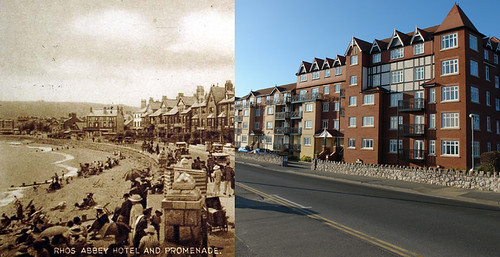
Rhos Abbey Hotel - Demolition

Rhos Abbey Hotel during demolition

Site of Rhos Abbey Hotel today (Photo Credit)

The Rhos Abbey Hotel, on the front in Rhos On Sea, was the village's largest hotel. Built in 1898, the large 32 bedroom red-brick building became a local landmark. Trade, however, began to decline in the 1980s and the hotel went bankrupt in August 1991. It was sold in October 1992 for £450,000, the new owner being David Owen of Llandudno's Tudno Castle Hotel. He announced plans for a 20 bedroom extension, swimming pool, sauna & steam room. Sadly, none of these ever materialised and the hotel limped on until 2000 when the owner submitted plans to demolish the hotel and replace it with 30 apartments. The application was refused by Conwy Council but overturned on appeal to the Welsh Assembly. Demolition took place in 2001 and the St Trillo's Court apartment building now stands on the site.

November 2000 - North Wales Weekly News:

"Yet another landmark hotel is to disappear from the Colwyn Bay area. The 32-room Rhos Abbey Hotel which has stood in its commanding position on the sea front at Rhos-on-Sea since 1898 is being demolished and the site turned into 30 apartments.

Conwy county council had refused planning permission for the development but the National Assembly Inspectorate over-turned the decision upon appeal, despite much local opposition to the loss of the famous hotel. As the N.Wales resort is supposed to be undergoing re-generation and the government is concerned about the country's tourism industry many folk consider this is retrogade step.

But the hotel's owner considered the area is finished as a tourist spot. The building is listed in Edward Hubbard's "Buildings of Clwyd" as one of only two buildings on Rhos seafront being worthy of mention. The other is Rhos Ffynach."

Rhos Abbey Hotel in the 1950s

Rhos Abbey Hotel in 1906

Tuesday, 13 October 2009

Power To The People!

Citizen Smith

Something I've been getting more and more concerned about over the last few years is the way in which public sector organisations (in particular, local Government) have become detached from the very communities they are supposed to be working for. All too often, we hear about supposed 'Public Consultations' and it is obvious that these are a complete sham - any decision that needed to be taken was made behind closed doors long ago. Indeed, I get the distinct impression that certain individuals view themselves as the the masters of the 'little people', rather than the public servants that they actually are.

I believe that we need to give new life to democracy in local Government and we can start with one major change to the present system, namely an elected Mayor for Conwy County.

Anyone can stand for Mayor, (subject to the same nomination procedure as for Councillors) and each candidate must set out set out a number of clear goals/objectives that their performance in achieving (or otherwise) can be judged against at re-election time. The position would operate in the same way as London's elected Mayor and would, therefore, have the power/financial budget to drive through their plans.

http://www.london.gov.uk/mayor/

What do you think?

Monday, 12 October 2009

Grand Theatre, Llandudno

Book of tickets from Grand Theatre - Friday, July 4th, 1958 (Photo Credit)

The Grand Theatre (now Broadway Boulevard nightclub) is situated on Mostyn Broadway, between Llandudno's town centre and the suburb of Craig Y Don. It opened on Monday, August 5th 1901 under the direction of Mr Milton Bode, one of the best known managers in the theatre world.

Grand Theatre - Front façade (Photo Credit)

The architect was George Humphries of Mostyn Estates, with renowned theatre architect Edwin Sachs as consultant. Built with a red brick façade topped by low semi-octagonal towers, the theatre seated 1,000, with two well curved balconies with eight rows of seats each and two boxes at either side of the first balcony and one box above. The boxes are divided by slim colonettes. A segmental arch with lattice decoration spans the auditorium above while the saucer dome ceiling has a plaster sunburst around a central rose. Plaster work on the proscenium, boxes and balcony fronts is of scrolls, festoons and musical instruments.

The Grand Theatre was primarily a play house, but musical comedies were also part of the staple diet. In the late 1920's, the theatre was fitted with a British Accoustic sound system and films were screened for several years, complementing the stage productions.

Grand Theatre under construction

Grand Theatre in the early years - note remote location!

The Grand Theatre closed as a theatre in 1980, and was reopened as the Grand Revivals nightclub in the late 1980s. It remains open as the Broadway Boulevard nightclub today, with large parts of the upper building being unchanged from its theatre days.


More details and photos to be added to this article soon!

Wednesday, 30 September 2009

Llandudno Cable Car

The age old question...is it a Cabin Lift or is it a Cable Car? And just what is the difference anyway? The answer is...it's now officially a Cable Car! It started out life as the Llandudno Cabin Lift Co. Ltd in 1969 but changed its name to the Llandudno Cable Car Ltd in 1988. Nowadays, it's owned by Kinetics Industrial Ltd.


Start of the journey...the Happy Valley Station


Inside the Happy Valley Station


Looking down at the Happy Valley Station (Photo Credit)

Regardless of the answer, Llandudno's Cable Car is a fine attraction. Apparently, it's the Longest Aerial Cable Car in the United Kingdom, with the distance between the two stations at Happy Valley and the Great Orme Summit being 1 mile and 40 feet exactly (5,320 feet).

While we are dealing with the stats.....
  • The Happy Valley Station is 135 feet above Sea level.
  • The Summit Station is 651 feet above Sea level.
  • There are 42 Cabins that travel at 600 feet per minute.
  • There are 9 intermediate tapering steel trestles support the cable between the stations.
  • The tallest trestle is 80 feet high with a base 5 feet 6 inches square - it weighs 15.3 tons.
  • 675 tons of concrete were used for the foundations and the steelwork weighs over 100 tons.
  • The longest span between the trestles is 1,023 feet.
  • The Cabins reach a maximum height of 160 feet above ground.
  • Each Cabin seats a maximum of 4 people
  • Each Cabin takes 9 minutes to reach the Summit (or vice versa)
  • Each Cabin is supported on an endless steel cable 2 miles long, weighing over 17 tons.
  • The hourly capacity of the Cable Car is stated to be 500 persons.
  • On an average day, each Cabin covers about 60 miles.
  • The cable has a nominal breaking strain of 50 tons, the factor of safety is 5.2.
  • The cabin lift is driven by a 100 h.p. slip ring electric induction motor at 1450 r.p.m.
  • A 50 h.p. internal combustion stand-by engine is kept in readiness for bringing cabins into the stations in case of power failure.

Cable Car with the Pier in the background (Photo Credit)


Two of the cabins pass high over Llandudno

Built at a cost of £125,000 (the contractor was British Chairlifts Limited/British Ropeway Engineering Co. Ltd who had previously built the EXPO 67 Cabin Lift: Details here), it was the idea of a Uttoxeter businessman called Anthony Bagshaw who had previously been involved with the Alton Towers theme park (where a similar Cabin Lift had been installed in 1963). It was opened for business by Lord Mostyn on the 20th June 1969 (after a certain amount of local opposition in the Council Chamber to the 'new fangled' idea which was rejected outright the first time it was proposed). It was also fully renovated in 2006 following the sale of the business by Uttoxeter Investment Co. Ltd. The purchaser was a local man, Andrew Jones, of Pyllau Farm on the Great Orme, who says he used to tell people that one day he would own it. He was also one of the first passengers when it originally opened in 1969.


A Cabin passes over one of the Trestles Photo Credit


View over the route of the Cabin Lift

The current operating season runs from 19th March to the 31st October, and it opens from 10am to 5pm daily during that time (may close earlier at beginning and end of the season). It's worth remembering that it cannot operate in high winds for safety reasons. Current ticket prices (2010) are £6-50 single and £7-00 Return, with a discount for families.

Top of the Great Orme! The Summit Station

The 100hp electric motor that drives the Cable Car
with the backup 50hp diesel engine to the left


Comment: I think the Cable Car is a fantastic asset to Llandudno but....one thing I've always wondered about it is...why don't they operate variable pricing? To explain, the Cable Car is like an airplane flight in that its costs are fixed, regardless of how many people are on the plane. So, as with the airline, it's in the Cable Car's interest to make sure that every seat is taken, even if you're occasionally selling it for a reduced price.

A lot of the time, the Cable Car seems to operate almost half empty - why not try offering discount fares for the beginning/end of the season and, also, for the beginning/end of each day, bringing the fare down to, say, £2? As someone with an interest in economics, it would be fascinating to see how demand increased or decreased based upon alterations to pricing.

Monday, 28 September 2009

Happy Valley Entertainers - the Return?

Over on his blog, Carneades makes a well thought out plea for talented amateur youngsters in the local area to step forward and grasp the opportunity to hone their skills on the amateur stage with Llandudno's musical groups. Which got me thinking....

Wouldn't it be great to try and revive Llandudno's long tradition of outdoor entertainment in the Summer? After all, open air entertainment in the Happy Valley has been a feature of Llandudno since the resort was founded, with the first performances believed to have been by a Husband & Wife Minstrel team in 1873:


They were followed by such resident acts as Perry's Happy Valley Minstrels, The Happy Valley Entertainers, Charles Wade's Concorde Follies and The Great Waldini and his Gypsy Band.


Of course, the heyday of this entertainment was when Alex Munro had his daily afternoon show at the Happy Valley Entertainers open air theatre in the Happy Valley in the 1960s, 70s and 80s. In the 1970s, Alex was holding 3 shows daily, 7 days a week, for an 18 week season.That added up to over 116,000 people watching his show in a typical year.


Sadly, the Open Air Theatre seen in the above photos was left to rot after Alex Munro left and ended its days as a wreck after a serious fire in October 1987. It was later demolished and the area landscaped as part of the Heritage Lottery Fund's £500,000 grant to renovate the park in 2000. Interestingly, the original plans by Howard Price of Ashley Price Associates for the redeveloped area included a stage for outdoor performances but this never materialised.


How it was...the 1970s


How it is now...(Photo Credit)

Obviously, the site of the Open Air Theatre is no longer suitable for use and I'm certainly not suggesting that a return to the daily afternoon show is a possibility...but...maybe a show or two every year on a balmy weekend afternoon or evening in August? Set up deckchairs in a semi circle on the large lawn in front of the Happy Valley Cafe, organise a small stage behind the Queen Victoria Statue, round up some talented individuals from Llandudno Musical Productions or the Trinity Players and you might just be in business. It would be just like the old days...and I'm sure Alex Munro would approve wholeheartedly!


The Happy Valley Lawn, suitable for outdoor entertainment? (Photo Credit).

Popular Posts